
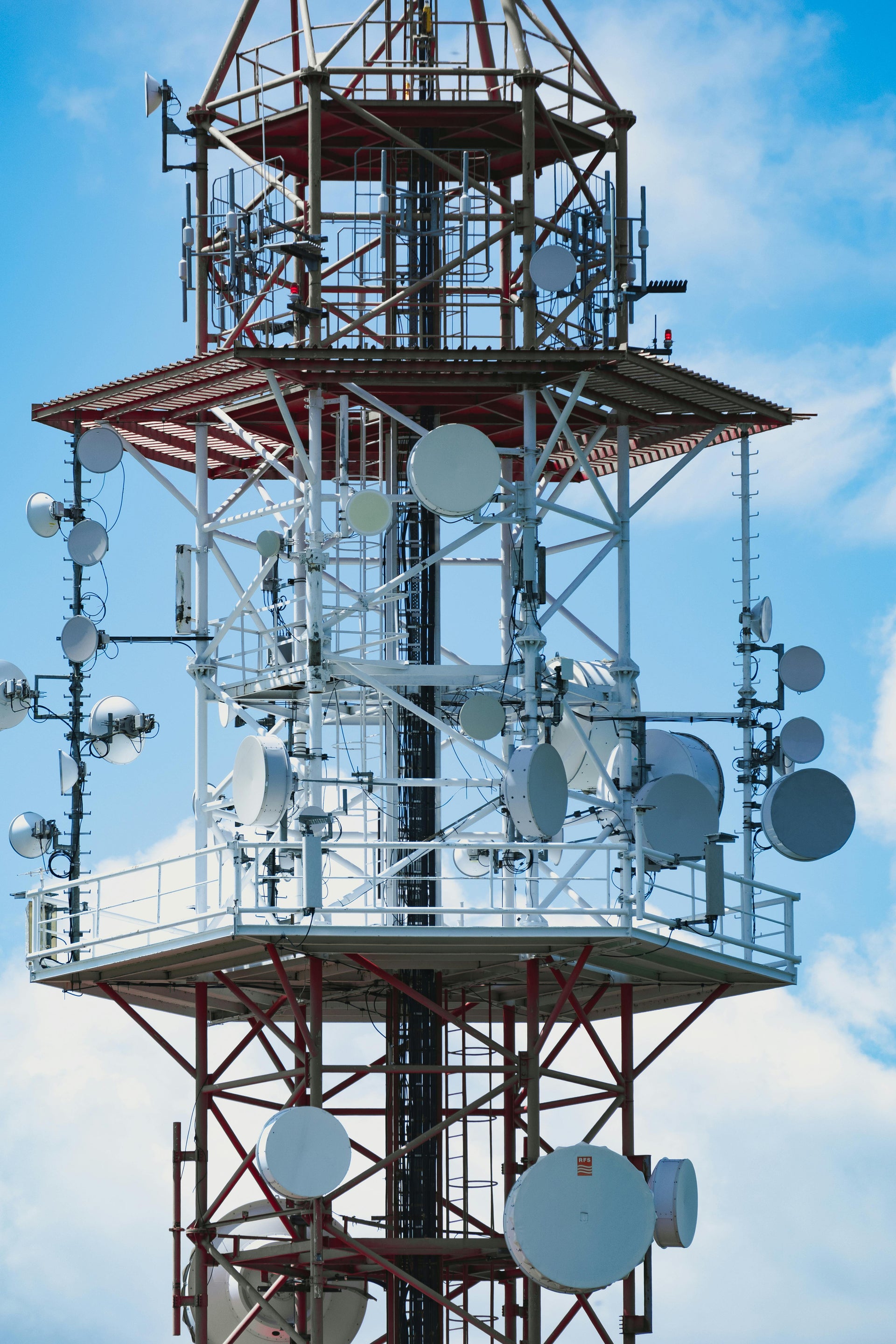

DAS Installation Services for High-Rise Buildings in Tampa
Tampa's high-rise inventory is concentrated in three pockets: the Downtown / Water Street redevelopment district (now anchored by 53-story 1010 Water Street and the Strategic Property Partners portfolio), the Westshore business district along Kennedy Boulevard, and the older Hyde Park / Bayshore residential corridor. The Water Street build-out alone added roughly 4 million square feet of post-2020 Class A office and residential, almost all of it impact-glass curtain wall over steel that requires active DAS from delivery. JB Technologies designs Distributed Antenna Systems for all three submarkets with hurricane-rated rooftop donor mounts to FBC HVHZ-adjacent wind standards.
Local context, Tampa, FL
The Water Street Tampa development is reshaping the city's DAS calculus, over a dozen new towers above 20 stories have come online since 2019, and Strategic Property Partners specifies multi-carrier DAS as a tenant-attraction baseline rather than a code minimum. Westshore is older Class B and Class A office stock from the 1980s-2000s with mixed concrete and steel; many of those buildings still operate single-carrier passive systems that no longer meet T-Mobile or AT&T coverage expectations. Hyde Park's mid-rise condos along Bayshore Boulevard face direct Gulf exposure, so rooftop donor antennas need salt-air-rated stainless mounts and quarterly inspection.
Why Choose JB Technologies for DAS in Tampa?
- Certified Nextivity / CEL-FI QUATRA Integrator
- Measurement-Driven RF Site Surveys and iBwave Design
- Multi-Carrier Coordination, Verizon, AT&T, T-Mobile
- FCC Part 90 / Part 22 / Part 24 Signal-Source Compliance
- Commissioning Sweeps and As-Built Documentation
What is DAS?
A Distributed Antenna System (DAS) is an engineered network of indoor antennas that distributes commercial cellular signal throughout a building so that tenants, employees, and visitors get reliable voice and data coverage on Verizon, AT&T, and T-Mobile. DAS solves the in-building coverage problem in two architectures. Passive DAS uses a donor antenna on the roof feeding a bi-directional amplifier and a coax-and-splitter distribution grid, cost-effective for buildings under roughly 150,000 square feet with a usable outdoor donor signal. Active DAS converts RF to digital at a head-end and distributes over fiber to remote units, scaling cleanly to multi-million-square-foot venues and supporting all major carriers through carrier-grade signal sources. When the outdoor donor is strong and the building is mid-sized, a single-carrier CEL-FI QUATRA deployment is often the right answer; when the donor is weak, the building is large, or true multi-carrier parity is needed, an active DAS is the durable choice.
Where DAS makes sense
DAS is owner- and tenant-driven, it is the answer to "why does my phone drop calls inside this building?" rather than a building-code mandate. Typical DAS candidates:
- Large floor plates, offices, hospitals, and campuses over roughly 50,000 sq ft where a single booster cannot cover the area.
- Dense concrete or steel construction, hardened cores and rebar-heavy slabs attenuate cellular signal 15 to 25 dB.
- Impact-rated or low-E glass, modern energy-efficient and hurricane-impact glazing attenuates PCS and AWS bands 10 to 18 dB.
- Multi-carrier requirements, tenants and visitors on Verizon, AT&T, and T-Mobile all need parity coverage.
- Below-grade and parking levels, basements, parking decks, and tunnels where macro signal does not penetrate.
- Healthcare facilities, nurse-call workflows, BYOD clinical apps, and patient-experience requirements.
- Hotels and mixed-use towers, in-room and amenity-floor cellular is a guest-experience expectation.
- Warehouses and distribution centers, metal-clad envelopes and dock-door geometry that block macro signal.
- Higher-education buildings, libraries, residence halls, and student centers with dense user counts.
- Stadiums, arenas, and conference venues, capacity-driven deployments, not just coverage.
Typical system costs.
DAS pricing varies with building size, donor-signal strength, carrier mix, and design topology. Two rough ranges hold across most commercial work:
Installed Cost Ranges
- Passive DAS, $0.75 to $1.50 per square foot for single-carrier or limited multi-carrier deployments with a clean donor signal, typical of mid-sized offices and mid-rise residential.
- Active multi-carrier DAS, $2.50 to $5.00 per square foot, driven by remote-unit count, fiber backbone length, carrier signal-source coordination, and AHJ requirements. Hospitals, stadiums, and campus deployments live in this range.
- RF site survey and design package, typically $1,500 to $5,000 depending on building footprint and the number of carriers in scope.
- Factors that drive cost:
- Donor signal strength, weak outdoor RSSI may force a tower-mounted amplifier, an off-air bi-directional amp upgrade, or a small-cell signal source.
- Building materials, concrete, low-E glass, impact glazing, and metal cladding each shift the design.
- Carrier mix, single-carrier QUATRA units are cheaper than tri-carrier active head-ends, and each added carrier requires its own Letter of Authorization.
- Retrofit vs new construction, pulling fiber and coax in finished spaces costs materially more than rough-in during the shell stage.
Permitting and Carrier Coordination
- Electrical and low-voltage permits, required in most jurisdictions for head-end power and cable distribution.
- Carrier Letters of Authorization (LOAs), active DAS using signal sources from Verizon, AT&T, or T-Mobile requires per-carrier LOAs and RF-emissions disclosure under FCC Part 90, Part 22, and Part 24.
- FCC signal-booster registration, consumer-class boosters must be registered with the operating carrier; commercial Part 20.21 systems are coordinated upfront.
Commissioning and Ongoing Support
- Commissioning sweeps, downlink and uplink RSSI measured at design points, exported to the building owner and the AHJ when applicable.
- Annual coverage verification, recommended after major tenant fit-outs, antenna relocations, or carrier band-plan changes.
- Warranty and remote monitoring, QUATRA and most active DAS head-ends ship with cloud monitoring; JBT maintains active alarms through a service agreement.
Key Takeaways
- Plan during shell construction, rough-in for fiber and coax pays back many times over versus a finished-space retrofit.
- Match the topology to the building, passive for smaller buildings with good donor, active for large or multi-carrier requirements.
- Confirm carriers early, the carrier mix dictates equipment selection, LOAs, and design timeline.
Tell us about your DAS project
Building address and a rough floor plate is enough to start. We'll respond within one business day with a probable DAS topology, donor-signal expectations, and a budget range.
Get a cellular coverage assessment for your Tampa project.
Send the building address and a rough floor plate; we'll come back with a probable DAS topology, donor-signal expectations, and a budget range within one business day.