
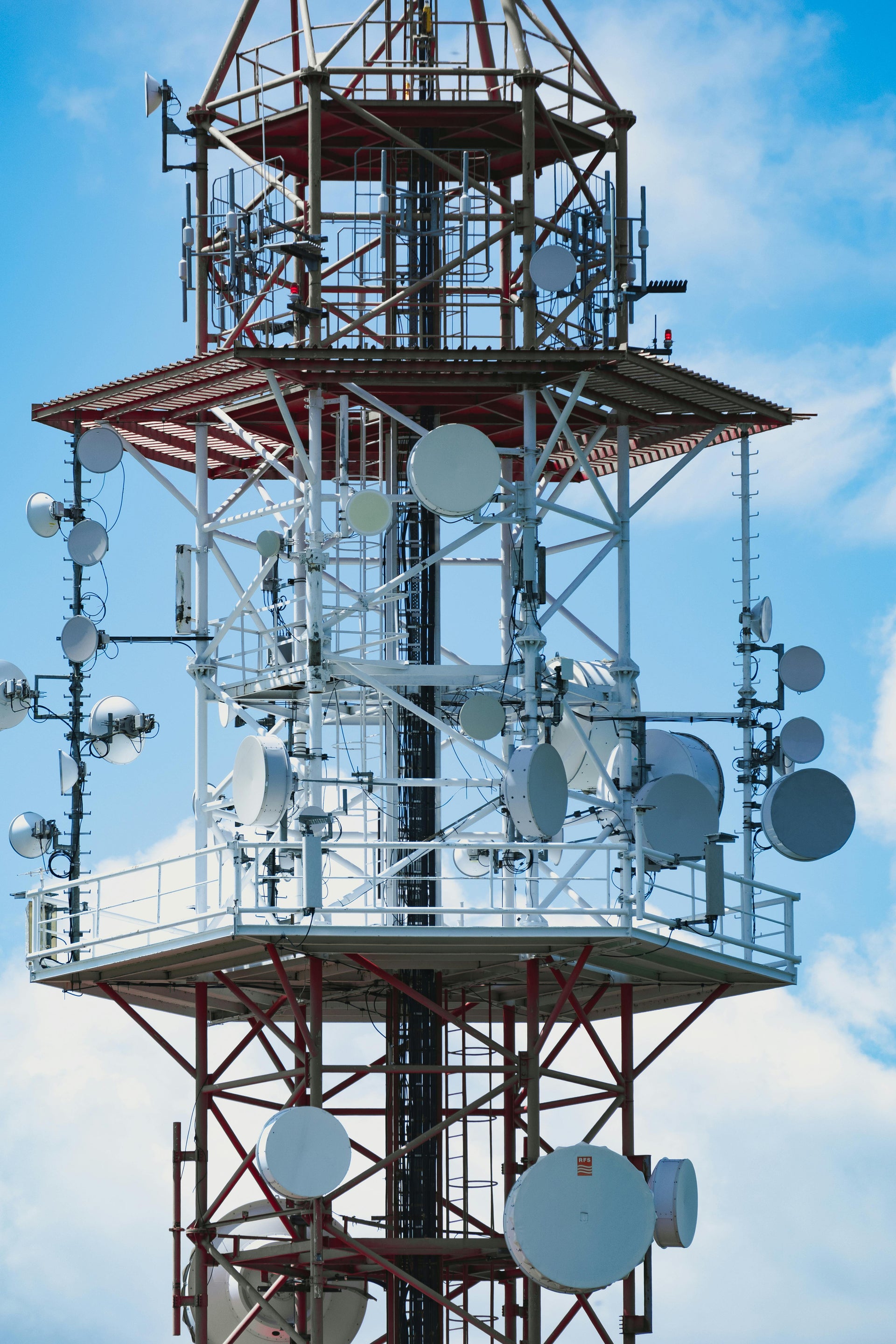

DAS Installation Services for New Construction Projects in Birmingham
Birmingham's medical-district and downtown high-rise pipeline is dominated by reinforced-concrete cores and Low-E curtain walls that routinely block cellular signal at street level. JB Technologies designs DAS solutions for new construction across Jefferson County, modeling donor signal from the dominant macro sites along Red Mountain and accounting for the long, narrow floor plates common to UAB-area medical office buildings. We work with GCs from schematic design through carrier-acceptance testing.
Local context, Birmingham, AL
Birmingham's terrain is the dominant DAS design variable: the ridge of Red Mountain physically shadows large parts of Southside and the UAB medical district from the macro sites on the north side of town, which is why even ground-level coverage in downtown garages often measures -95 to -105 dBm on Verizon Band 13. New medical office buildings going up around UAB Hospital and Grandview routinely use shielded radiology suites and lead-lined imaging rooms that need their own indoor antenna branches. Jefferson County permits cellular-DAS work under the standard low-voltage / electrical permit through the City of Birmingham Department of Planning, Engineering & Permits, and humid Alabama summers push us to spec head-end gear with conservative thermal margins in non-conditioned IDF closets.
Why Choose JB Technologies for DAS in Birmingham?
- Certified Nextivity / CEL-FI QUATRA Integrator
- Measurement-Driven RF Site Surveys and iBwave Design
- Multi-Carrier Coordination, Verizon, AT&T, T-Mobile
- FCC Part 90 / Part 22 / Part 24 Signal-Source Compliance
- Commissioning Sweeps and As-Built Documentation
What is DAS?
A Distributed Antenna System (DAS) is an engineered network of indoor antennas that distributes commercial cellular signal throughout a building so that tenants, employees, and visitors get reliable voice and data coverage on Verizon, AT&T, and T-Mobile. DAS solves the in-building coverage problem in two architectures. Passive DAS uses a donor antenna on the roof feeding a bi-directional amplifier and a coax-and-splitter distribution grid, cost-effective for buildings under roughly 150,000 square feet with a usable outdoor donor signal. Active DAS converts RF to digital at a head-end and distributes over fiber to remote units, scaling cleanly to multi-million-square-foot venues and supporting all major carriers through carrier-grade signal sources. When the outdoor donor is strong and the building is mid-sized, a single-carrier CEL-FI QUATRA deployment is often the right answer; when the donor is weak, the building is large, or true multi-carrier parity is needed, an active DAS is the durable choice.
Where DAS makes sense
DAS is owner- and tenant-driven, it is the answer to "why does my phone drop calls inside this building?" rather than a building-code mandate. Typical DAS candidates:
- Large floor plates, offices, hospitals, and campuses over roughly 50,000 sq ft where a single booster cannot cover the area.
- Dense concrete or steel construction, hardened cores and rebar-heavy slabs attenuate cellular signal 15 to 25 dB.
- Impact-rated or low-E glass, modern energy-efficient and hurricane-impact glazing attenuates PCS and AWS bands 10 to 18 dB.
- Multi-carrier requirements, tenants and visitors on Verizon, AT&T, and T-Mobile all need parity coverage.
- Below-grade and parking levels, basements, parking decks, and tunnels where macro signal does not penetrate.
- Healthcare facilities, nurse-call workflows, BYOD clinical apps, and patient-experience requirements.
- Hotels and mixed-use towers, in-room and amenity-floor cellular is a guest-experience expectation.
- Warehouses and distribution centers, metal-clad envelopes and dock-door geometry that block macro signal.
- Higher-education buildings, libraries, residence halls, and student centers with dense user counts.
- Stadiums, arenas, and conference venues, capacity-driven deployments, not just coverage.
Typical system costs.
DAS pricing varies with building size, donor-signal strength, carrier mix, and design topology. Two rough ranges hold across most commercial work:
Installed Cost Ranges
- Passive DAS, $0.75 to $1.50 per square foot for single-carrier or limited multi-carrier deployments with a clean donor signal, typical of mid-sized offices and mid-rise residential.
- Active multi-carrier DAS, $2.50 to $5.00 per square foot, driven by remote-unit count, fiber backbone length, carrier signal-source coordination, and AHJ requirements. Hospitals, stadiums, and campus deployments live in this range.
- RF site survey and design package, typically $1,500 to $5,000 depending on building footprint and the number of carriers in scope.
- Factors that drive cost:
- Donor signal strength, weak outdoor RSSI may force a tower-mounted amplifier, an off-air bi-directional amp upgrade, or a small-cell signal source.
- Building materials, concrete, low-E glass, impact glazing, and metal cladding each shift the design.
- Carrier mix, single-carrier QUATRA units are cheaper than tri-carrier active head-ends, and each added carrier requires its own Letter of Authorization.
- Retrofit vs new construction, pulling fiber and coax in finished spaces costs materially more than rough-in during the shell stage.
Permitting and Carrier Coordination
- Electrical and low-voltage permits, required in most jurisdictions for head-end power and cable distribution.
- Carrier Letters of Authorization (LOAs), active DAS using signal sources from Verizon, AT&T, or T-Mobile requires per-carrier LOAs and RF-emissions disclosure under FCC Part 90, Part 22, and Part 24.
- FCC signal-booster registration, consumer-class boosters must be registered with the operating carrier; commercial Part 20.21 systems are coordinated upfront.
Commissioning and Ongoing Support
- Commissioning sweeps, downlink and uplink RSSI measured at design points, exported to the building owner and the AHJ when applicable.
- Annual coverage verification, recommended after major tenant fit-outs, antenna relocations, or carrier band-plan changes.
- Warranty and remote monitoring, QUATRA and most active DAS head-ends ship with cloud monitoring; JBT maintains active alarms through a service agreement.
Key Takeaways
- Plan during shell construction, rough-in for fiber and coax pays back many times over versus a finished-space retrofit.
- Match the topology to the building, passive for smaller buildings with good donor, active for large or multi-carrier requirements.
- Confirm carriers early, the carrier mix dictates equipment selection, LOAs, and design timeline.
Tell us about your DAS project
Building address and a rough floor plate is enough to start. We'll respond within one business day with a probable DAS topology, donor-signal expectations, and a budget range.
Get a cellular coverage assessment for your Birmingham project.
Send the building address and a rough floor plate; we'll come back with a probable DAS topology, donor-signal expectations, and a budget range within one business day.